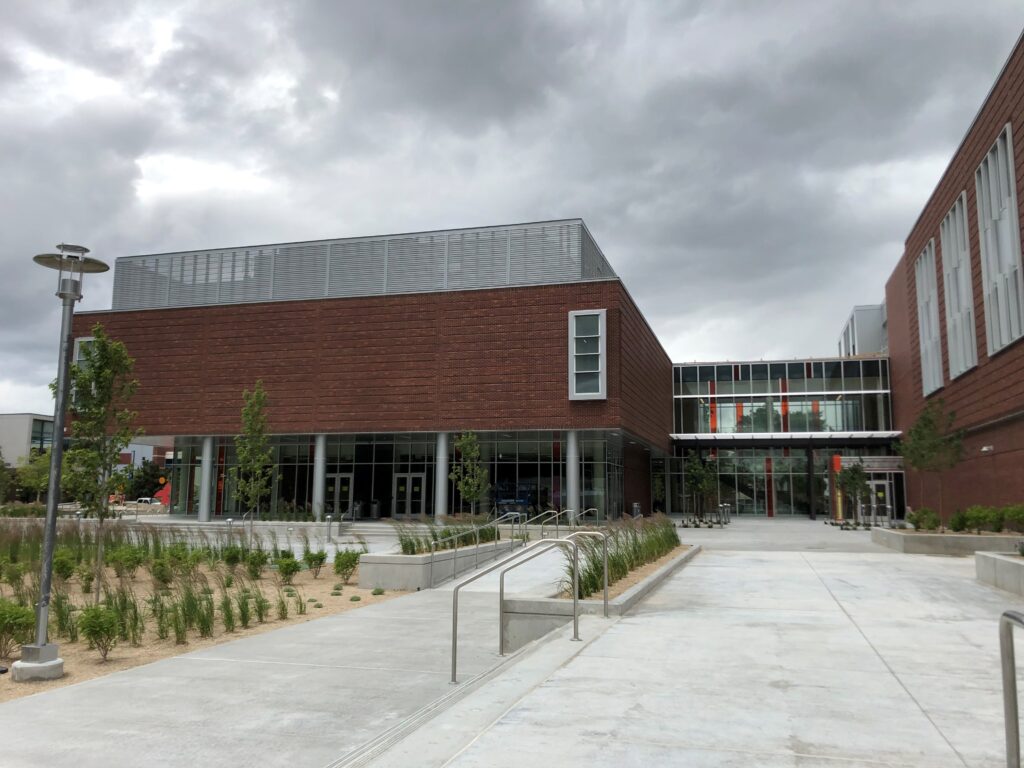
Project description
The new facility includes teaching spaces, research and computational laboratories, faculty offices, a 250-seat lecture hall, and two 80-seat classrooms. We designed the building to optimize energy performance while maintaining occupant and operator safety. Energy monitoring and utility metering are provided on each floor and at key divisions throughout the building. Monitored utilities include air, chilled water, process chilled water, heating water, domestic and industrial water, and electrical power. These data are displayed on electronic signage to educate occupants and promote energy-use awareness and reduction.
The mechanical design includes five air-handling units (AHUs): three serving laboratory spaces, one serving office and administrative areas, and one serving the auditorium and large classroom spaces. A new water-cooled chiller plant located in the penthouse accommodates the building’s cooling load with two 250-ton chillers. The dual-chiller configuration provides partial redundancy for reliability and allows for improved part-load control.
A laboratory vacuum system and compressed air system were designed to serve the research areas. Specialty gases, including nitrogen, liquid nitrogen, and carbon dioxide, are distributed from cylinder manifolds to laboratory outlets. Type II DI/RO water is circulated throughout the building to serve pure water outlets and user-supplied DI polishers at the point of use.
The electrical design supports all occupant-required equipment and general and specialized power needs. Provisions for backup power ensure occupant safety during primary power outages. Lighting was designed for all interior spaces and coordinated with the site layout to ensure appropriate illumination and energy efficiency.
The technology systems include IT room design, cable tray distribution, access control infrastructure, video surveillance, CAT 6A copper cabling, and wireless access points (WAPs) to provide robust connectivity and system integration throughout the facility.
Guiding Principles for the Design
- Smart Building Technology
- Advanced Laboratory Systems
- Future-Ready Facilities
- Precise Facility Controls
- Adaptive Learning Environments
- Student-Focused Design
- Safety and Security
- Sustainable Operations