Project description
The project included a 25,000-square-foot computer laboratory designed to support 6 MW of lab equipment. This fast-track project required early design packages and pre-purchase coordination for major equipment to meet aggressive scheduling goals.
Constructed in two phases approximately two years apart, the facility’s electrical service consists of two independent systems, each equipped with a utility transformer, paralleled UPS systems, and paralleled diesel generator systems to ensure reliability and redundancy.
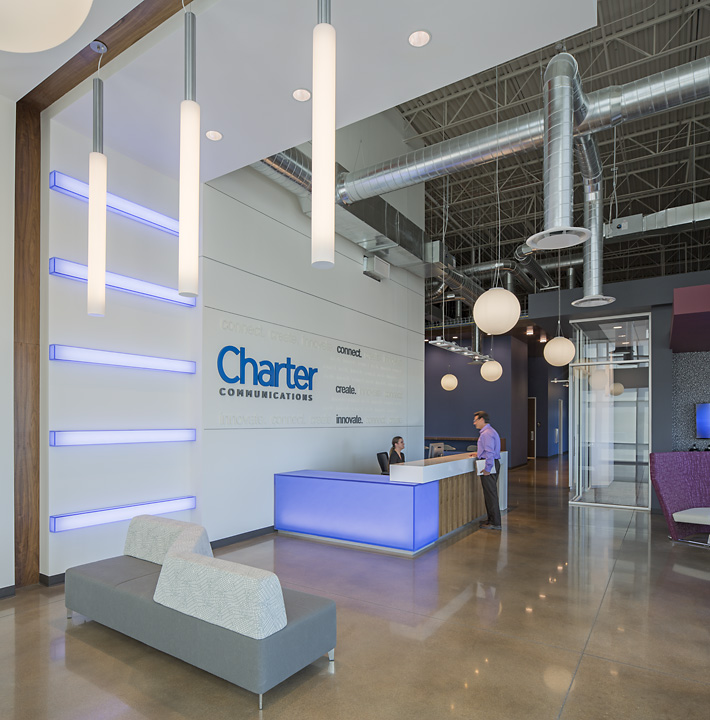
The 30-foot-high structure, typical of manufacturing environments, presented both opportunities and challenges for mechanical and electrical design, requiring careful consideration of comfort, lighting, and aesthetics within the large-volume space. This high-volume configuration later allowed the addition of a 10,000-square-foot mezzanine for new office space to accommodate Charter Communications’ expanding staff following initial construction.
The data center was designed with a modular approach, allowing capacity to be scaled up over time to align with operational needs and budget.
Innovative mechanical systems included a pumped refrigerant economizer for the computer room air conditioning (CRAC) units serving the data center and lab. This system utilizes a refrigerant pump instead of compressors during periods of cool outdoor air temperatures, significantly reducing power consumption. Additionally, heat recovery from the hot aisle containment of the laboratory was used to preheat outside air for the office spaces, improving overall energy efficiency.
Over the course of the phased expansion, both electrical and cooling capacities within the data center were increased and ultimately quadrupled, ensuring long-term scalability and performance.
Guiding Principles for the Design
- Heat Recovery Integration
- Fast-Track Delivery
- Timeless Design
- Operational Resilience
- High-Performance HVAC
- Scalable Infrastructure
- Safety and Security
- Adaptive Spaces